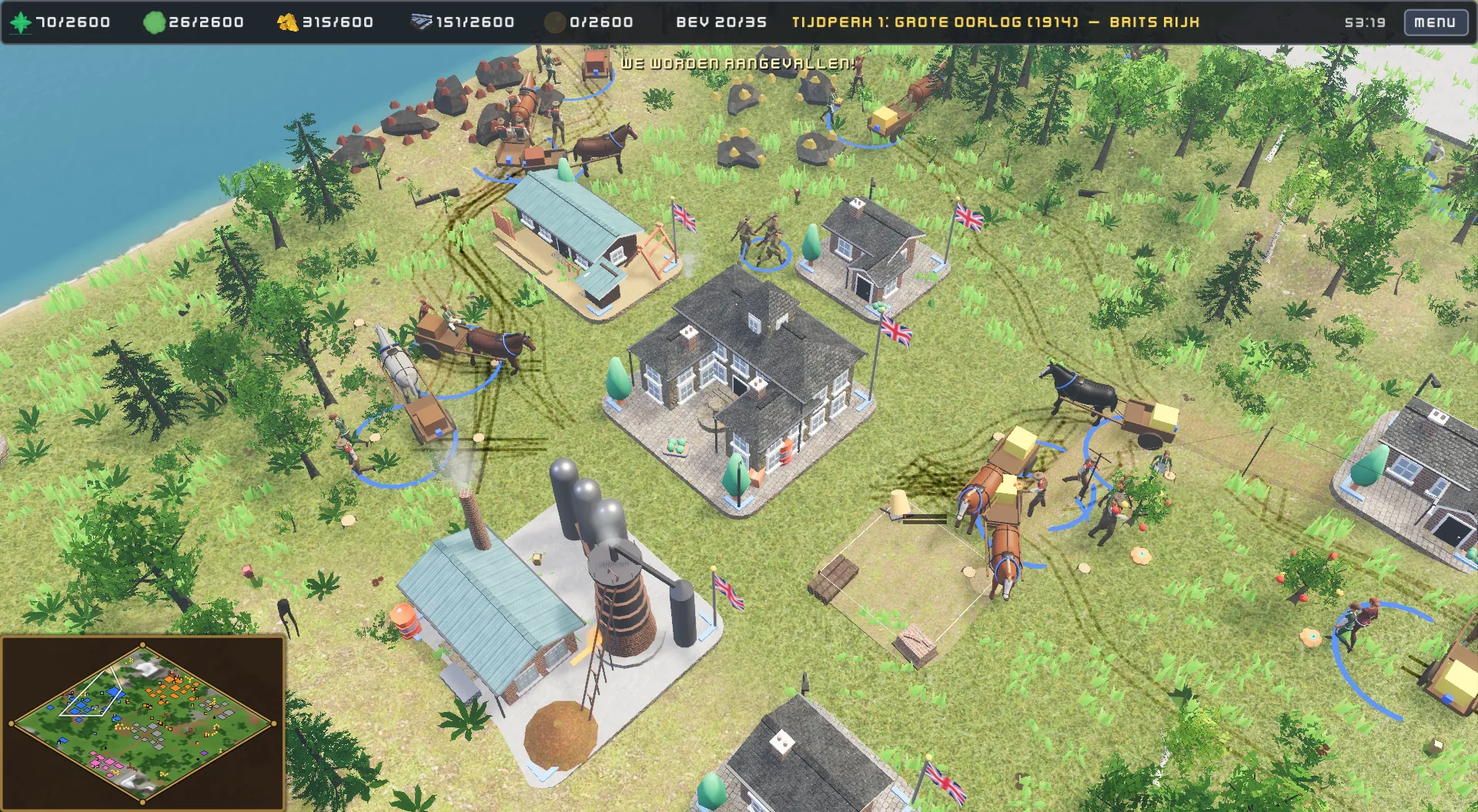
A living battlefield
Commanding the Century is packed with details you only notice when you zoom in, and mechanics you only notice when they cost you a match. Here they all are, in one place.
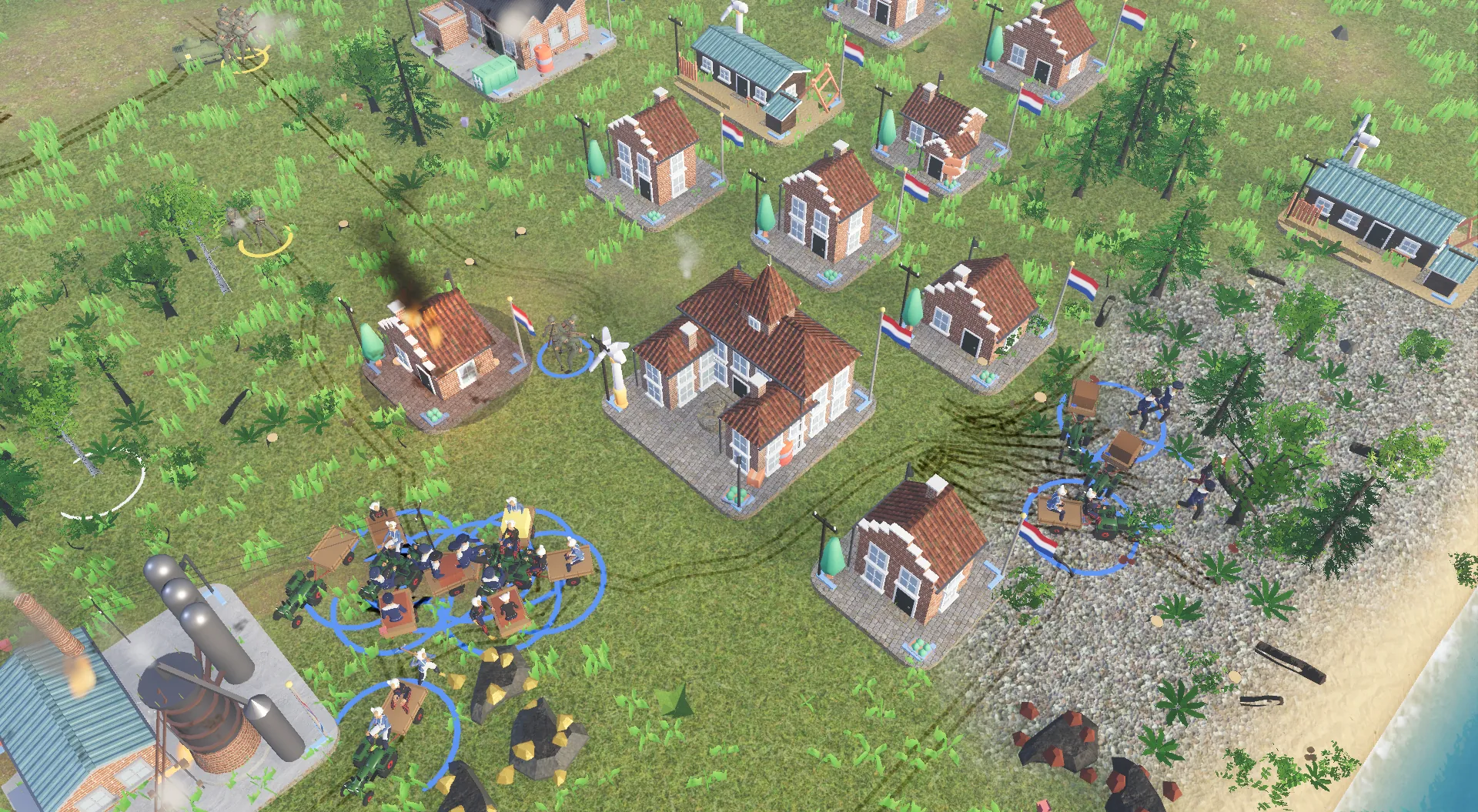
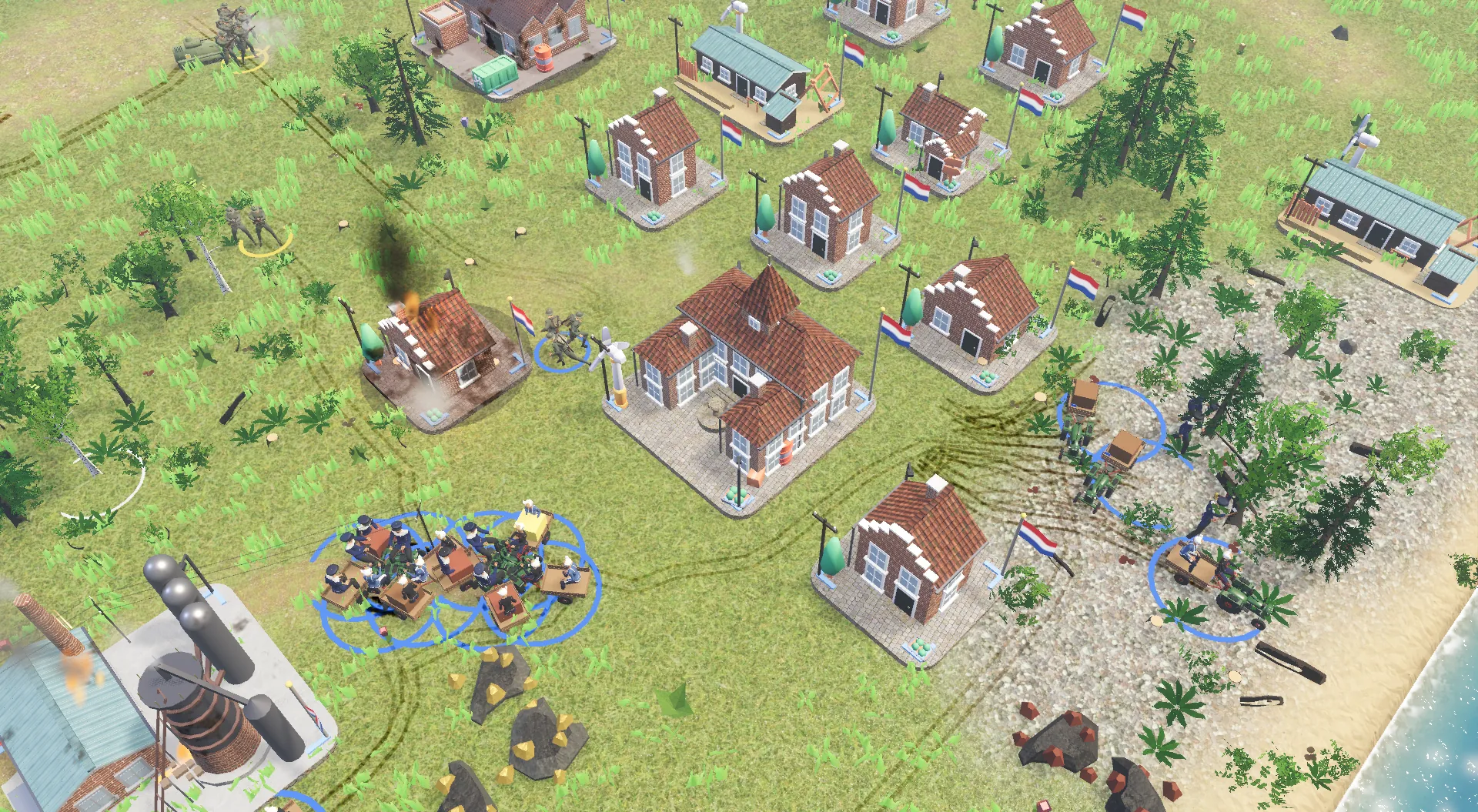
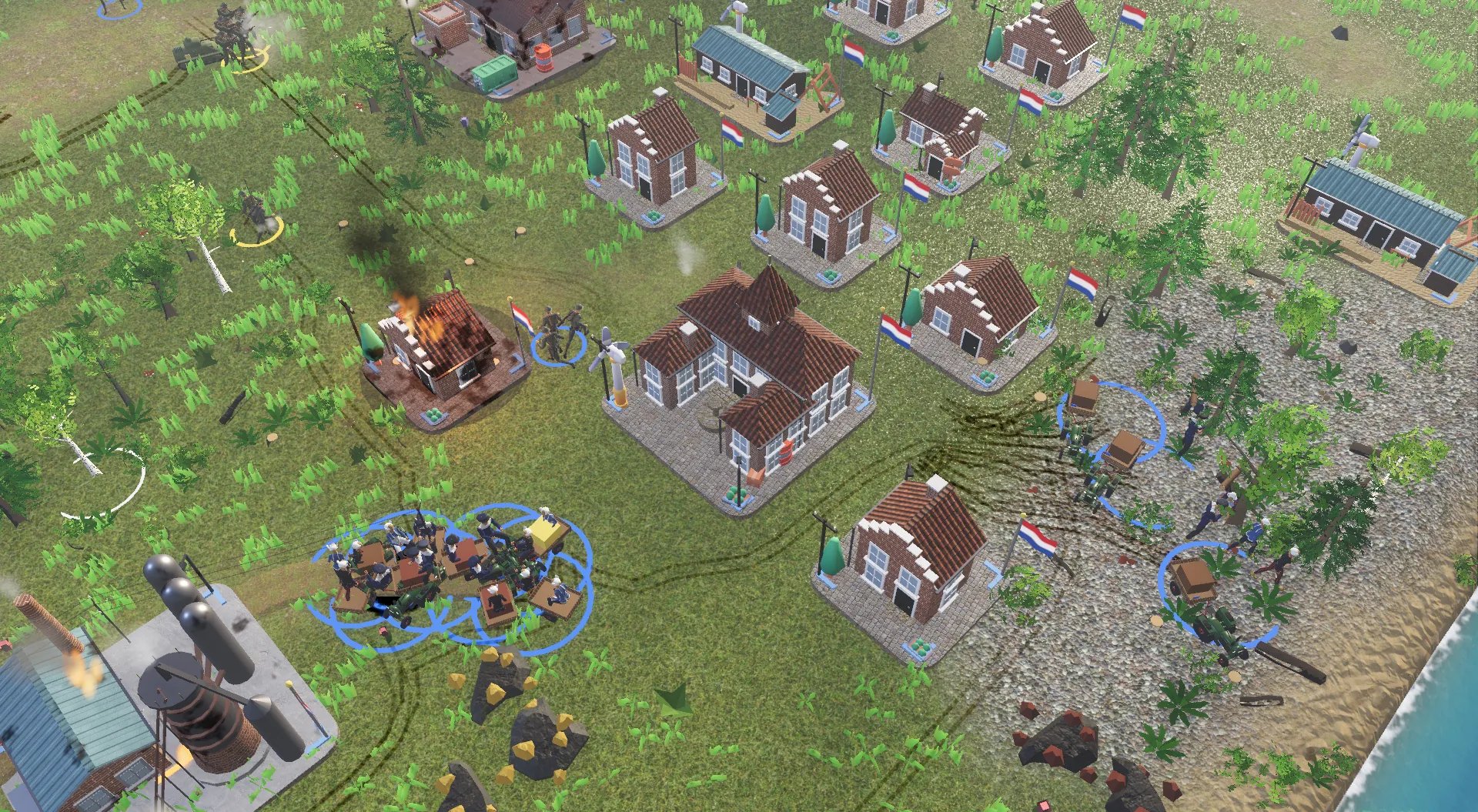
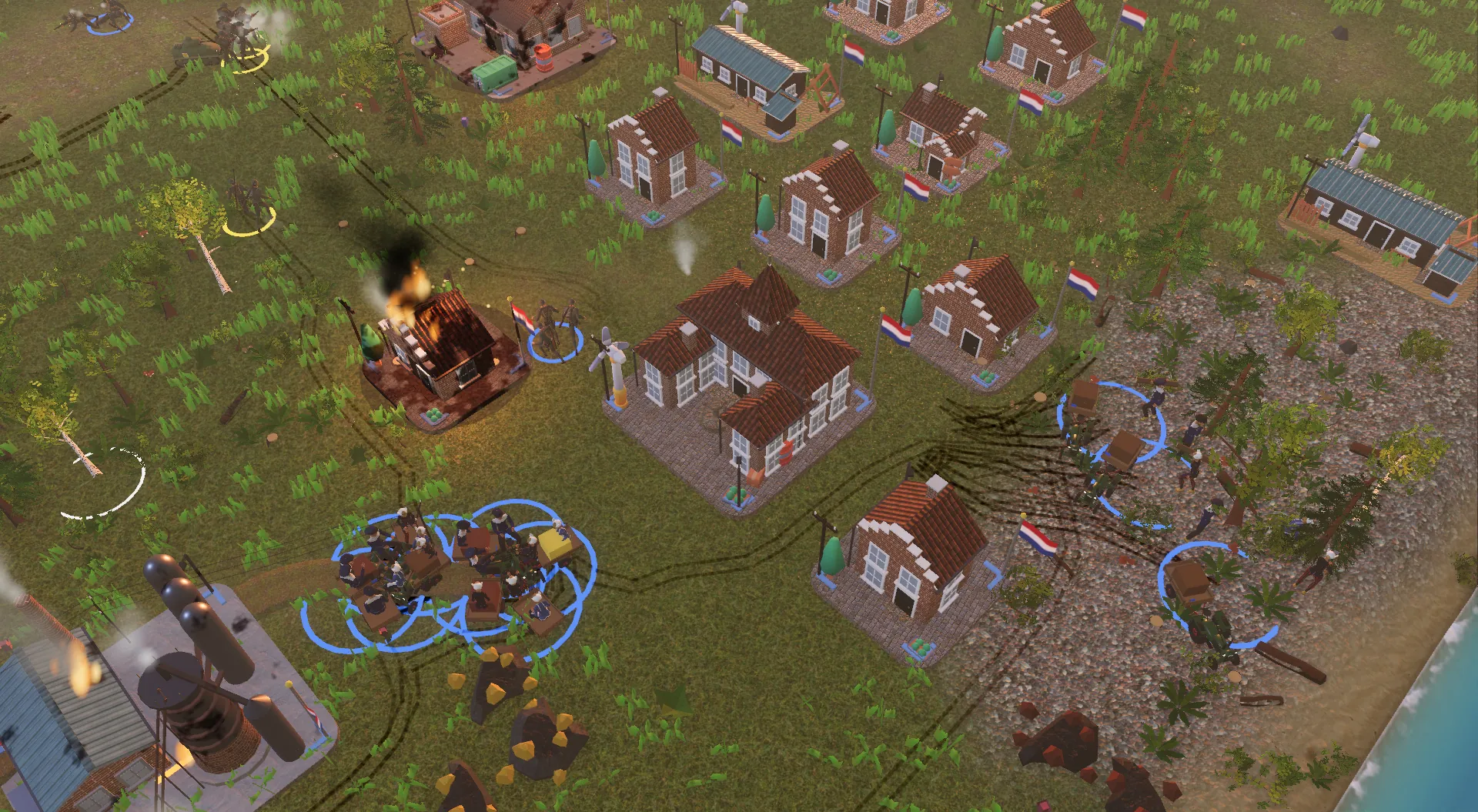
 Midday
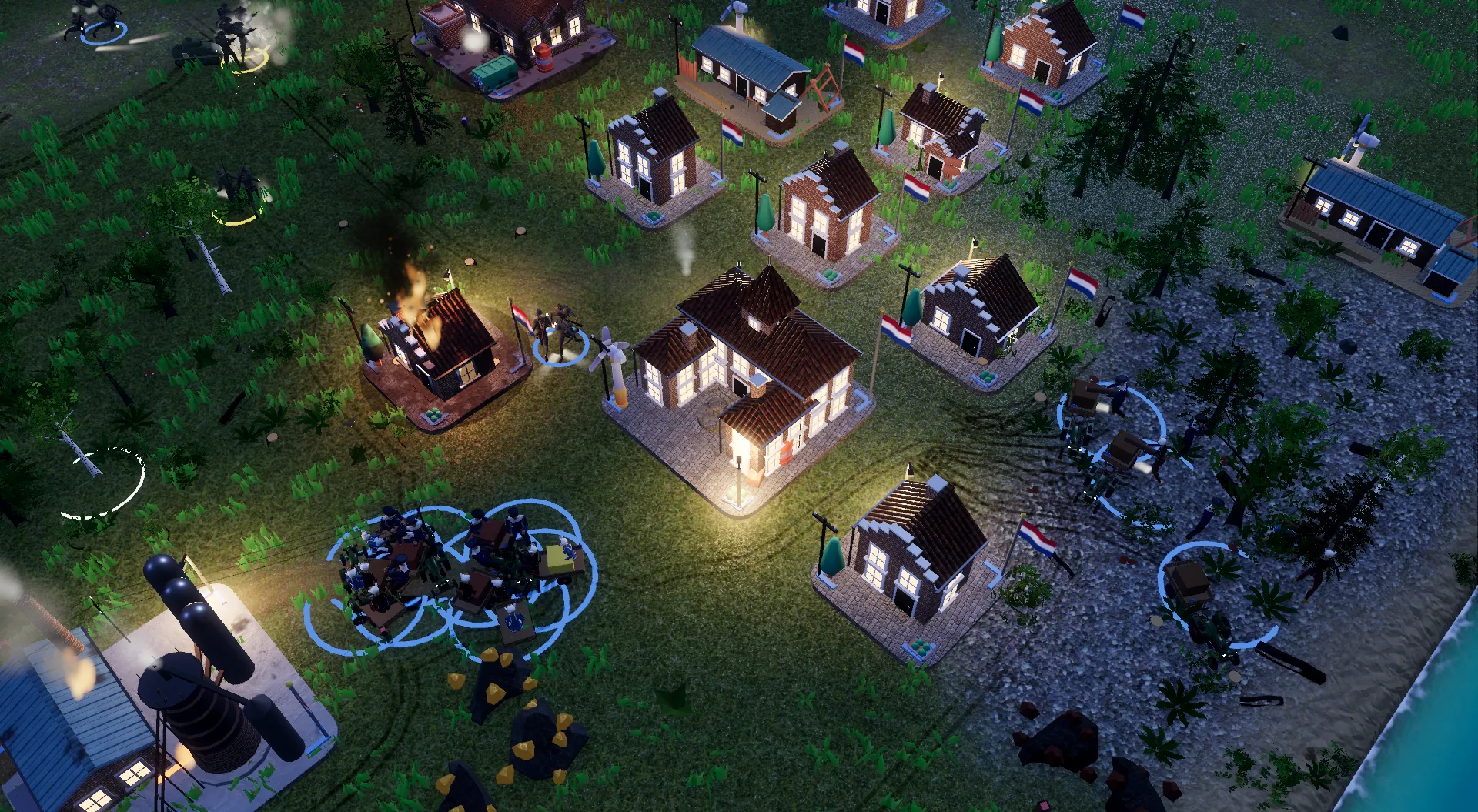
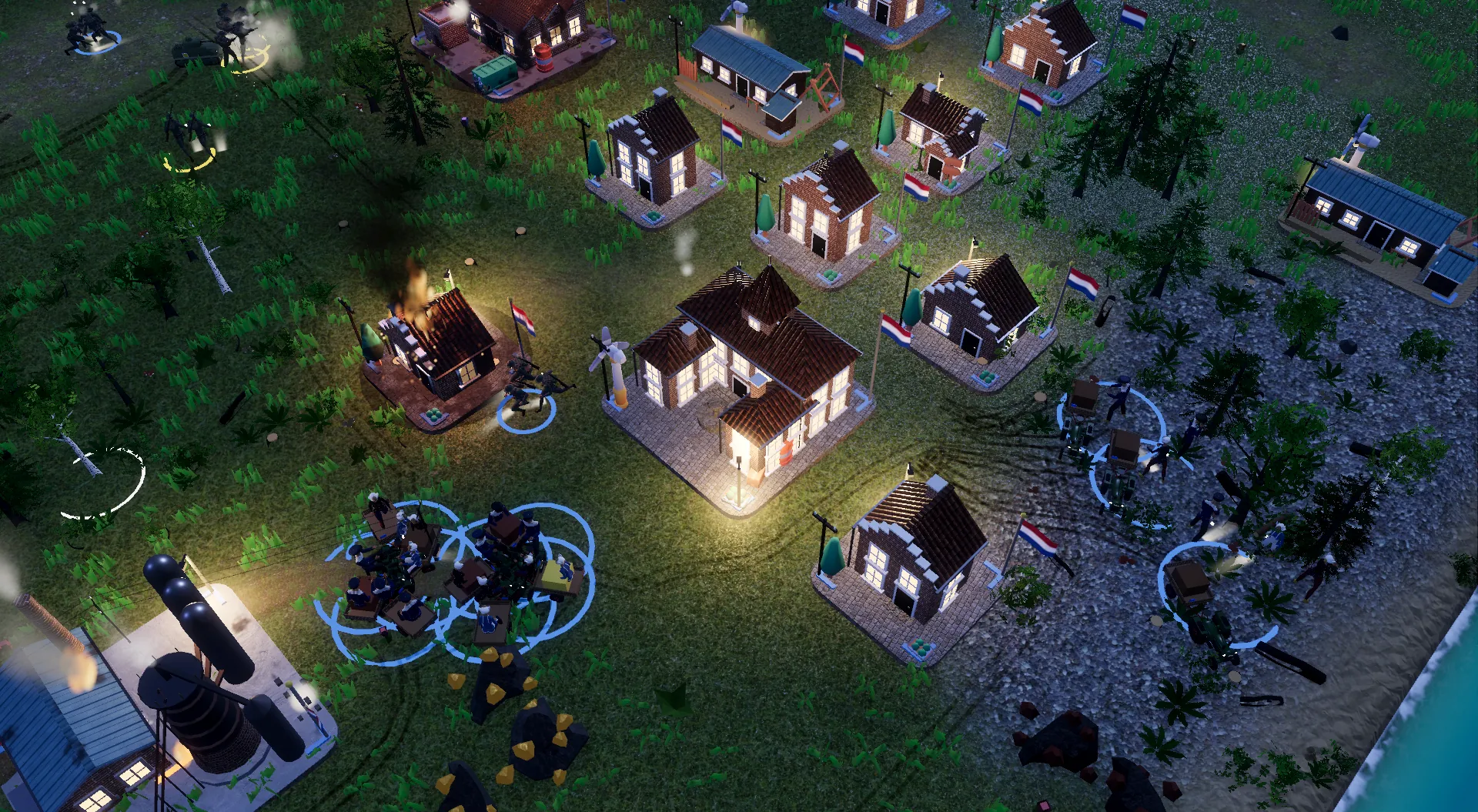
Day and night
Every match starts in the morning, with the sun low over the eastern horizon. After about 29 minutes it sets, followed by a quarter of an hour of true night, and at around 47 minutes the sun rises again. Slide through the day above: it is the same Dutch base every time.
- A real sky: physically based atmosphere with an HDR cloudy sky. A low sun casts warm orange light and long shadows; at night, blue moonlight shines.
- Lights come on: from sunset, windows, lampshades and street lanterns light up, with soft pools of light on the ground and real light sources for the lanterns closest to the camera.
- Headlights: ground vehicles cast a beam of light on the ground ahead of them.
- Navigation lights: aircraft carry red on port, green on starboard and a white strobe that flashes every 1.3 seconds. Ships have masthead lights, sidelights and a warm glow on deck.
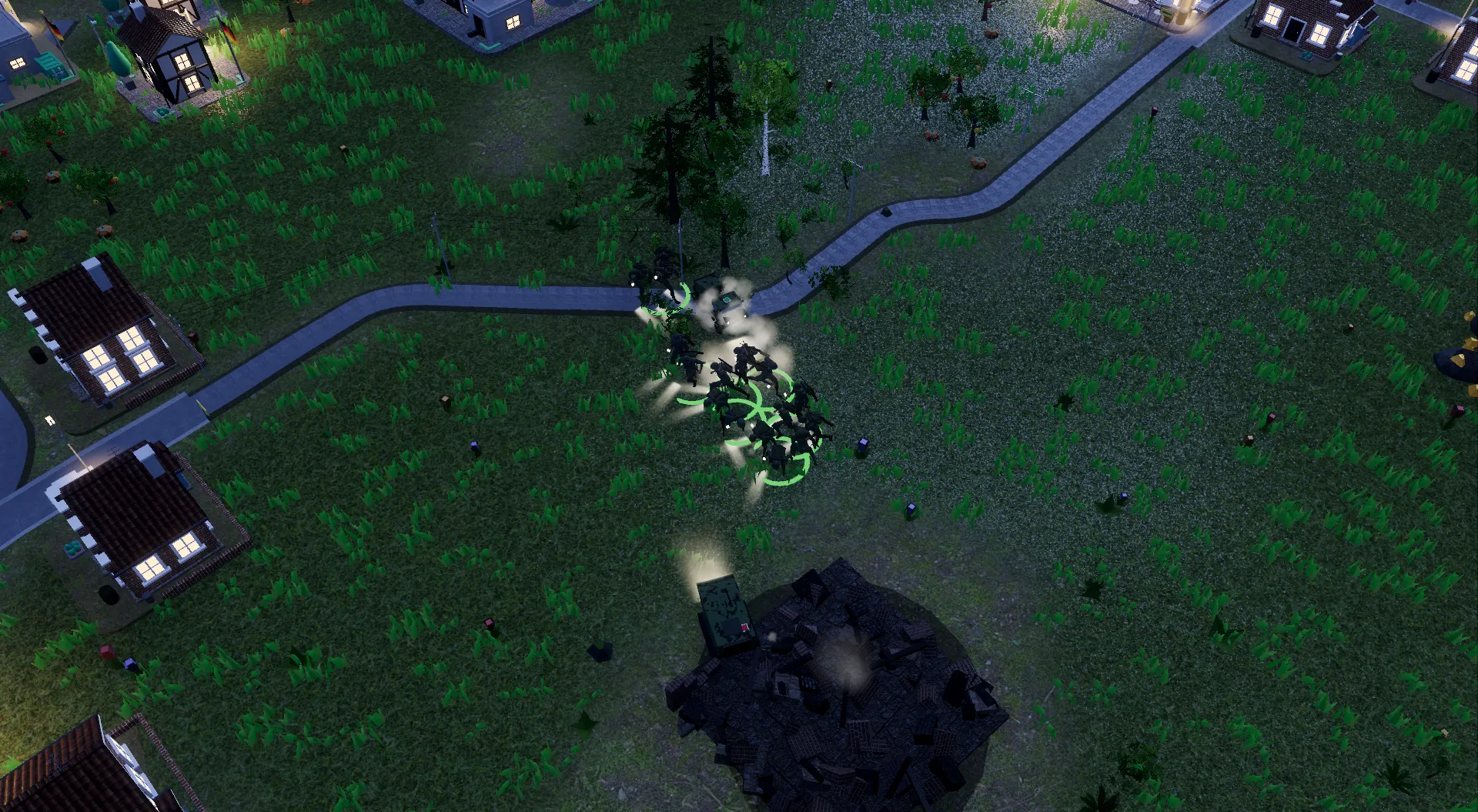
- Torches: soldiers on the move switch on their torches when it gets dark enough. The beam sways with their arm and stays on for a moment when they stop.
- Saved: the time of day is part of the match and simply carries on after loading.
Fighting in the dark
The night isn't just beautiful, it changes the fight. Light yourself up and you will be seen.
- Limited vision: at night you only see unlit enemy units at 55% of your normal sight range. That also applies to anyone firing at them automatically.
- Light gives you away: vehicles, aircraft and ships are always lit; soldiers only while they walk with their torches on.
- Lights off N: switch off headlights, navigation lights and torches. Your column then creeps through the night and is only noticed at close range.
- Thermal imaging: the recon drone and the spy satellite also see unlit units at full range.
Maps and villages
Every map is generated from a seed, so everyone on the network gets exactly the same world. The terrain has hills, sandy beaches that continue under the water, and water rendering with ripples, foam along the coast and caustics on the seabed. Grass sways in the wind, and wherever you dig a trench it disappears.
Trees shake and rustle as you chop them, their crowns thin out and they topple once the wood runs out, leaving a stump behind. Fishing grounds have a school of fish beneath the surface, a buoy with a little flag and rings on the water.
| Map type | Character | Villages in the style of |
|---|---|---|
| Plains | Balanced, lots of space | Netherlands |
| Ardennes | Dense forests, ideal for ambushes | France |
| Desert | Oil, oases and flat roofs | Italy |
| Lakes | Many lakes with narrow passages | Russia |
| Rivers | Rivers with bridges split the map into fronts | Germany |
| No Man's Land | Crater fields and rocks | Great Britain |
| Inland Sea | Water in the middle: the fleet decides | United States |
| Islands | An island for every player, plus a central island | Japan |
Sizes: small (64×64), medium (96), large (128) and huge (160 tiles).
Neutral villages
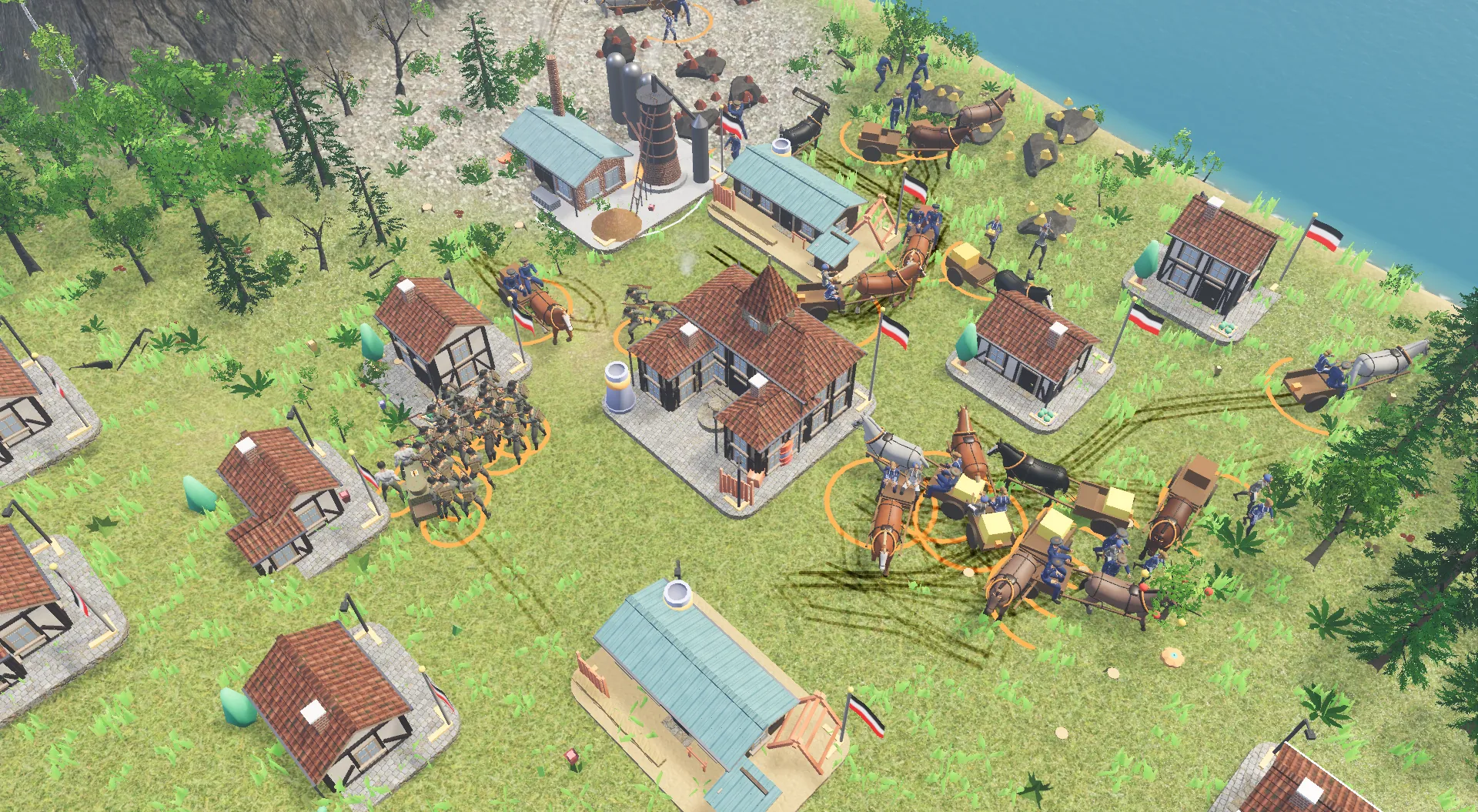
Every map has 2 to 7 villages, with a square, crossing streets, a church and an inn, farms on the outskirts and fields beyond. Roads link the villages to each other and to the starting positions.
Villages that age
The villages follow the players' average age. Dirt tracks become cobblestones and then tarmac with road markings. Telegraph poles become concrete poles. Street lanterns, bus shelters, phone boxes and parked cars appear, and after 1918 a war memorial on the square.
Occupy the church
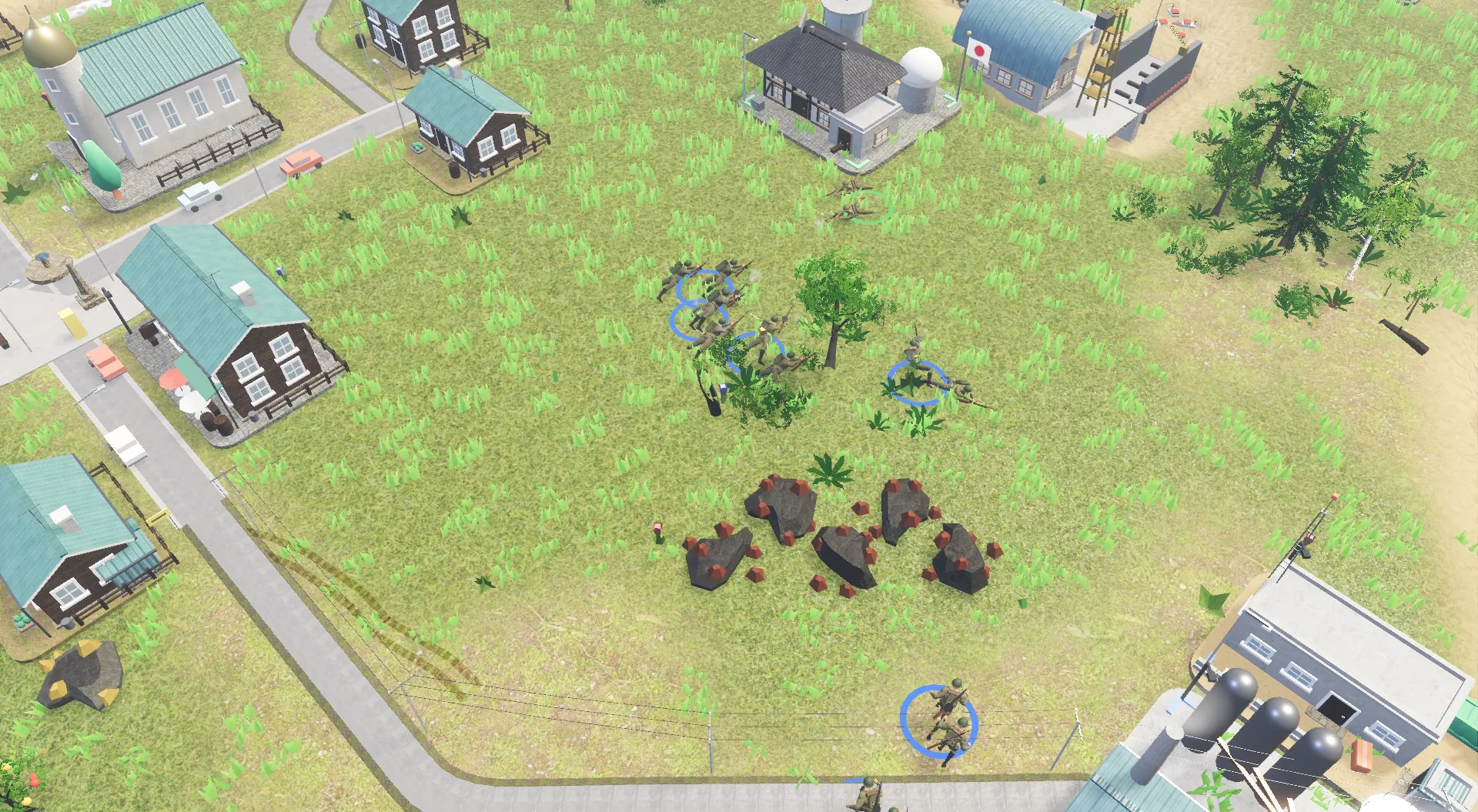
Infantry can occupy village buildings and fire from the windows: 4 men in a cottage, 8 in the church, which can also see further. The building then raises your flag. If it collapses, the garrison loses a quarter of its health.
Cover and stance
Trenches
Click and drag to dig a line of up to 40 sections. Soldiers inside take only 35% of direct damage and 60% from nearby impacts. Tracked vehicles can cross them, wheeled vehicles cannot. The revetment keeps up with the times: posts, sandbags, corrugated iron, HESCO.
Bunkers
A bunker doesn't fire on its own: put up to six soldiers inside. They fire from the loopholes with 40% more range and are invulnerable. If the bunker falls, they come out.
Going prone
Press G and soldiers go prone: half damage, but they crawl at 30% speed. Anyone firing from a fixed position goes prone automatically. They really crawl, with alternating knees and a wobbling upper body.
Running
Press R and your soldiers run 40% faster, but take 20% more damage. Roads help too: infantry moves 30% faster on them, wheeled vehicles 60%.
Effects down to the shell casing
- Muzzle flash by calibre, side jets from the muzzle brake, smoke rings and dust kicked up from the ground.
- Shell casings: brass casings fly from the breech and bounce across the ground.
- Recoil: barrels kick back and slide forward again, hulls rock and soldiers take a jolt to the shoulder.
- Real ballistics: tracer rounds, artillery shells in an arc, rockets with smoke trails and whistling bombs.
- Impacts: sparks on armour, fountains of earth, ricochets, black puffs of flak in the sky and columns of water. A naval gun produces a fireball and a shockwave that flattens the water.
- Burning buildings: below 75%, 50% and 25% health, soot, fires and smoke appear, from light grey to pitch black, with an orange glow. Then they collapse in a cloud of dust, leaving a pile of rubble.
- Tracks: tracks and tyres leave marks that fade after three minutes.
- Sinking ships tilt bow or stern up as they burn.
Work crews
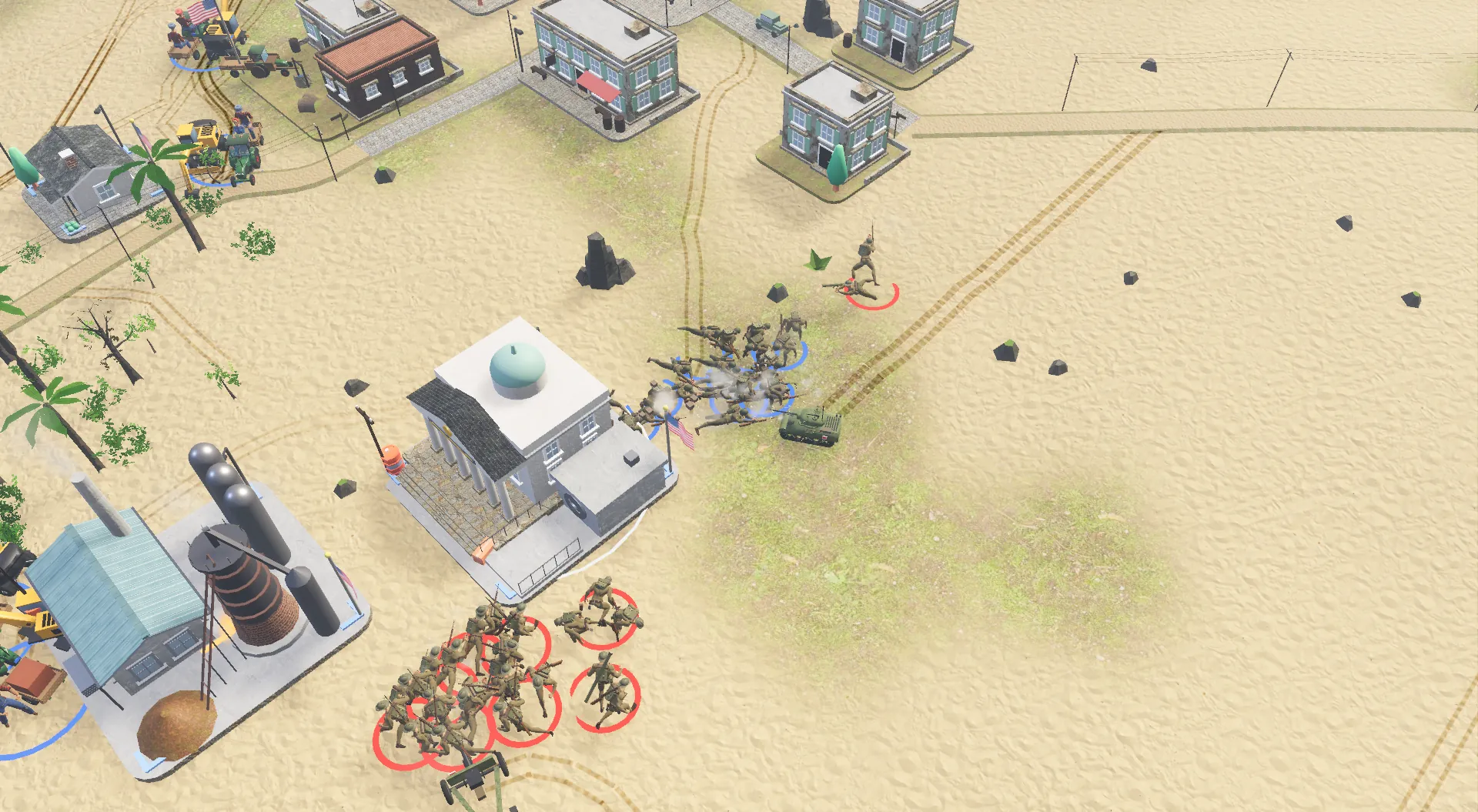
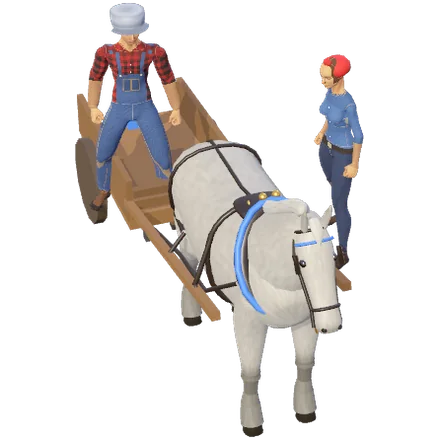
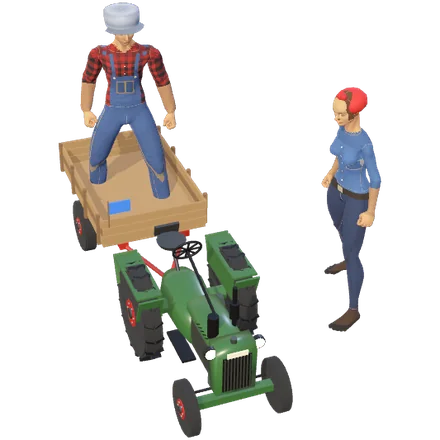
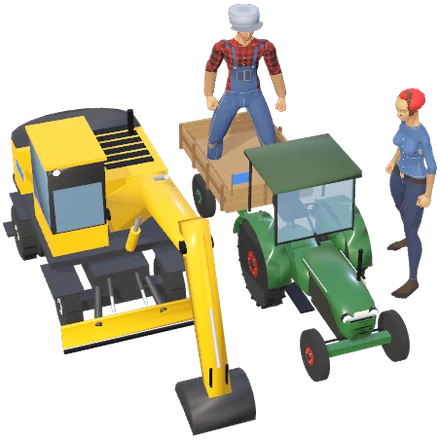
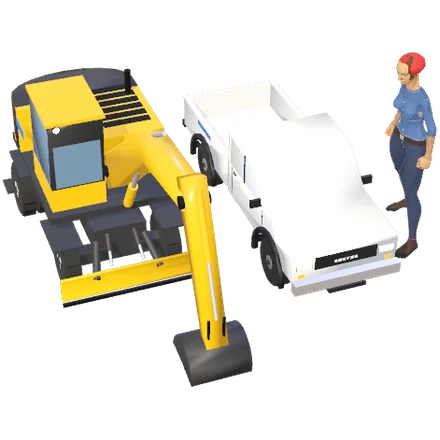
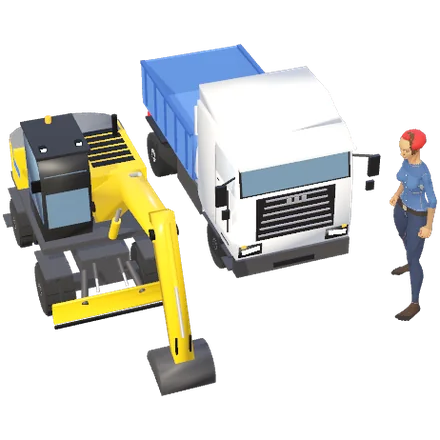
Your workers don't wander around on their own: they are crews with a vehicle. They ride on the box seat or in the cab, climb out at the job and park the vehicle alongside. With every age, the crew works 20% faster.
The horse
A fully animated draught horse with 19 bones, walk and trot, moving ears and tail, a resting hind leg and a harness with a collar in your player colour.
Real work
Chopping with an axe or chainsaw, breaking ore with a pickaxe or jackhammer, picking fruit, hoeing and harvesting, and hammering, alternately standing and kneeling. A helper hauls logs, ore or baskets to the vehicle.
Men and women
About half of the crew are women. Until 1939 they wear their country's cap, after that a hard hat in the national colours.
Economy
Five resources
Food from orchards, farms and fishing grounds, wood from the forest, gold from mines, steel from iron ore and oil from derricks on oil fields.
Storage you can see
Resources are physically stored in the headquarters (1000 of each type) and in warehouses (800). Once everything is full, you build a new warehouse. Construction takes its materials from the nearest warehouse, and a destroyed warehouse loses its contents.
Steelworks
Workers bring iron ore to the blast furnace, which smelts it into steel. As long as there is ore, the furnace glows and throws sparks.
Fishing
Steam drifters and later stern trawlers fish the fishing grounds and bring the catch to the harbour.
Roads
Lay your own roads for 5 wood per tile. Units automatically take the road if it isn't too much of a detour, and roads cannot be shot to pieces.
Bank and stock exchange
A shared stock exchange with prices that react to every player, war bonds with interest and vaults ripe for plunder. More about the bank.
Air force
- Fuel and ammunition: a fighter flies for 80 seconds with 48 shots, a bomber for 100 seconds with 4 bombs, and every age adds a little more.
- Automatic return: below 20% fuel or out of ammunition, an aircraft returns on its own. An empty tank means half speed and half firepower.
- Refuelling and rearming at the airfield costs oil and steel. An airfield has room for 5 aircraft.
- Aircraft carriers are floating airfields for 3 to 6 aircraft, which park on the deck.
- Each country's own jets: in the Cold War, for example, the F-16, MiG-21, Mirage III, English Electric Lightning, F-104G Starfighter and Fiat G.91, and today the F-35A, Su-57, Rafale, Eurofighter Typhoon, Mitsubishi F-2 and F-35I Adir.
At sea
- Real ship classes: from HMS Dreadnought and the aircraft carrier HMS Argus in dazzle camouflage to the Iowa, the Kirov, the Visby, the De Zeven Provinciën and the Nimitz.
- Submarines are invisible until a destroyer or frigate detects them, within 6 tiles. After firing a torpedo they are visible for 4 seconds. Only anti-submarine units and other submarines can hit them.
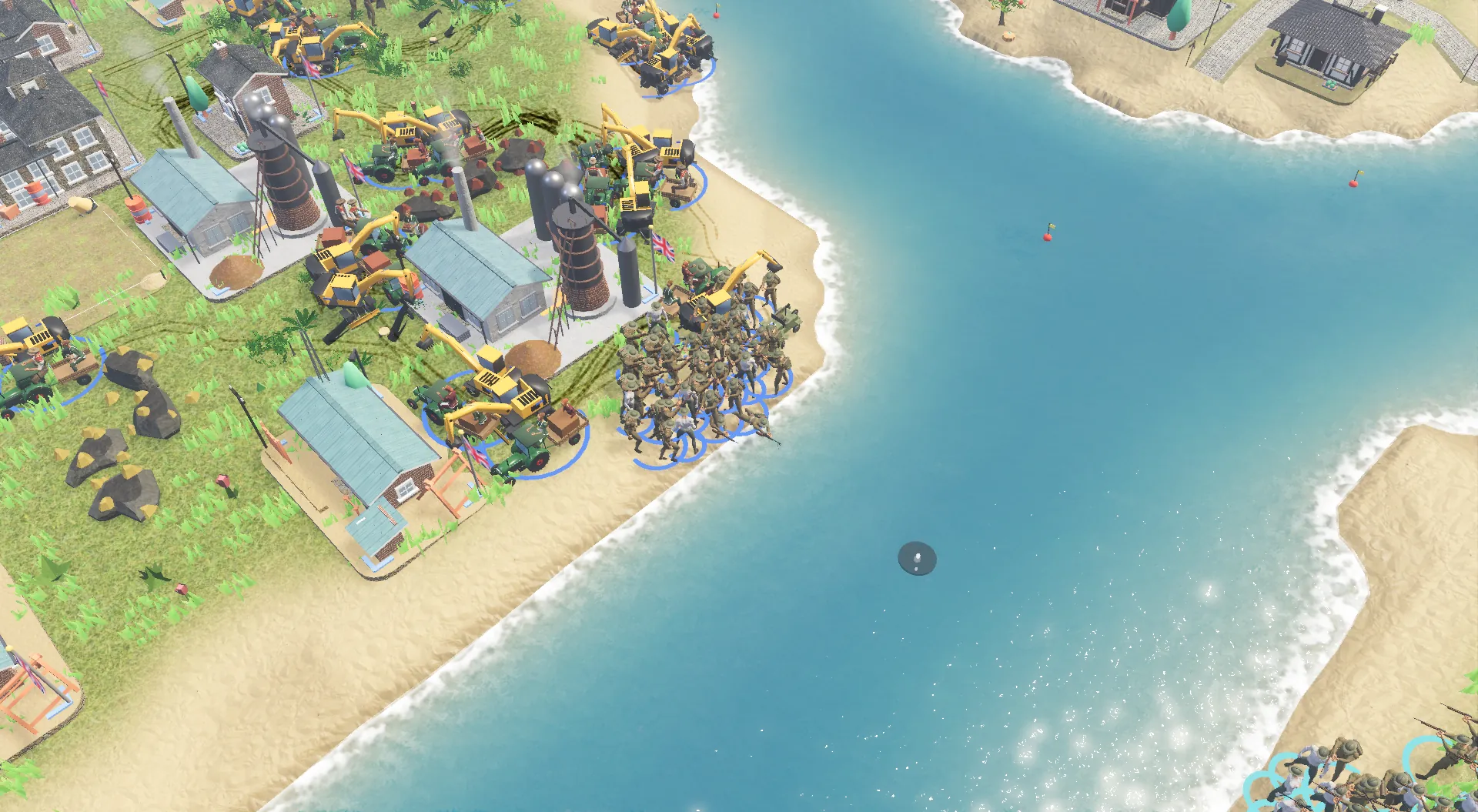
- Landings: load troops and tanks into a landing craft, from the X-Lighter to the LCAC hovercraft with 16 places, and put them ashore on the enemy coast.
- Coastal batteries grow from a 6-inch gun into an NSM missile battery.
Scouting and drones
Fog of war
You can always see the terrain, but enemy units only within your sight range. Allies share their vision, and enemy buildings stay visible once you have spotted them.
Radar
The radar station (1960) scans an area of 11 tiles. Green dots show where something is and how big it is, but not what it is. A radar sweep rotates across the ground.
Satellite
Once researched, the spy satellite reveals everything in an area of 7 tiles for 40 seconds, even in the dark.
Drones
The drone operator launches a recon drone (F) and flies it ahead while kneeling. The battery lasts 80 seconds and the link reaches 24 tiles. When the battery is almost flat, it returns on its own. Kamikaze drones circle for 150 seconds and then dive onto their target.
Every country flies its own drones, such as the RQ-11B Raven, Black Hornet 4, EMT Aladin, Eleron-3SV and Skylark I-LEX for reconnaissance, and the Switchblade 600, IAI Harop, ZALA Lancet-3, Helsing HX-2 and HERO-120 as kamikaze drones.
AI opponents
The computer uses exactly the same commands as you do. Only on Very hard does it gather 30% faster. On Hard and above it adapts its plan: an AI that is losing badly with harassment or blitzkrieg after eight minutes switches to attacking. It trades on the stock exchange, occupies bunkers and sends drones ahead.
| Easy | Normal | Hard | Very hard | |
|---|---|---|---|---|
| Reaction time | 3 s | 1.5 s | 1 s | 0.5 s |
| Max. work crews | 10 | 16 | 22 | 28 |
| First attack | 9 min | 6 min | 4 min | 3 min |
| Between waves | 240 s | 170 s | 130 s | 100 s |
| Min. wave size | 5 | 8 | 10 | 13 |
- Defender: bunkers, anti-aircraft, artillery and snipers; occupies villages and attacks late, but hard.
- Harasser: raids workers and isolated buildings with motorcycles, armoured cars and helicopters.
- Attacker: extra barracks and factories, large armies and battleships.
- Builder: lots of workers, races through the ages and then fields a modern army with missiles.
- Air force: 70% of the army in the air, aircraft carriers and kamikaze drones.
- Blitzkrieg: advances fast, early tanks with bombers and frequent attacks.
- Admiral: harbours, a fleet and landings, only on maps with water.
Sound
All 173 sounds were made in-house using synthesis: separate rifles and machine guns for every age, a minigun, flak, torpedoes, depth charges and whistling bombs. There are engine sounds for the WWI tank, motorcycle, turbine, helicopter, propeller aircraft, jet fighter, bulldozer, pumpjack and horse and cart, and work sounds for chopping, sawing, picking and hammering. Everything sounds in 3D from where it happens.
- Ambience per map: wind and birds, desert wind, or surf and seagulls on sea maps.
- Fanfares for a new age, an alarm when you are under attack, and dedicated jingles for victory and defeat.
- 300 voice lines in ten languages: German, British and American English, French, Russian, Dutch, Italian, Japanese, Hebrew and Arabic. Tank, aircraft and ship crews speak over the radio.
Give it a try
Interface
- 3D thumbnails: all buttons and icons are rendered at the start of a match in your architectural style and player colour.
- Info cards: hover over a unit and see its stats as bars, along with what it is strong and weak against. For research you see the values now and after the next level.
- Minimap shaped as a rotating diamond, with relief, water depth and forests in a bronze frame.
- Build preview: a transparent model of the building, and a green or red line for walls and trenches.
- Automatic quality: choose Low, Medium or High. If your PC drops below 24 frames per second, the game steps down a level by itself.
- Living main menu: behind the menu lies your nation's village in the golden hour. Workers chop and build, soldiers patrol and aircraft fly overhead.
- Two languages: Dutch and English, switchable in the menu.